17 February 2026
Students in rural Kenya participate in a reading program supported by a Rotary global grant.
By Temrah Okonski, Rotary Club of Ellicott City, Maryland, USA
I have never been to Kenya. Yet over the past two years, as updates, photos, and reports from a Rotary-supported basic education and literacy (BEL) grant arrived in my inbox, I watched a project I helped shape on paper turn into something real.
From the first draft to final approval, the grant took nearly two years. At times, the process felt slow and challenging. But as the proposal moved through revisions and conversations between my club in District 7620, the host and international sponsor Rotary Club of Machakos, Kenya, in District 9212, and our partner, Kenya Connect, the questions we were asked forced us to sharpen our goals, strengthen our plan, and think carefully about sustainability.
Looking back now, as I see the results, I am glad that I persevered. The support I received from Carolyn Johnson, a member of The Rotary Foundation Cadre of Technical Advisers, past District Governor Barton Goldenberg, and Regional Grants Officer Nora Beamish-Lannon was invaluable to the project’s success.
When I first began working with the Rotary Club of Machakos, located in the Mwala sub-county, we knew we needed to focus on literacy in rural Kenya. I was drawn to our partnering organization, Kenya Connect, and its belief that children and families who have access to books learn to love reading, and are therefore more likely to become strong readers.
In the Mwala sub-county, many students grow up without electricity, internet, or print materials at home. English, the language used for Kenya’s national exams, is often their third language, making success in school even more challenging. Kenya Connect was already known as a reputable organization helping this community strengthen educational outcomes.
Our BEL grant expanded upon Kenya Connect’s already successful, community-wide approach to reading. Rather than focusing on a single intervention, the project helped Kenya Connect increase access to their mobile library program, Saturday Storytimes, and reading clubs for students and parents. The grant also supported teacher trainings developed with local educators. Books were delivered directly to schools and to Kenya Connect’s library, ensuring consistent access for learners.
Some of the most meaningful moments for me came through photos of students proudly holding their library cards. Other images showed mothers engaged in learning and a full house during Saturday Storytime. As part of the grant’s evaluation process, teachers shared that students who were once hesitant to read aloud were now volunteering to read and were participating more confidently in class.
As the final reports came in, student test results told a compelling story. Across participating schools, students showed steady improvement in reading, language, and overall academic performance. This was very exciting!
What stood out most was how Rotarians became part of a shared effort to make reading accessible, valued, and joyful. Essential to the grant’s implementation was the trust that developed between my club and the host club. Regular communication, careful financial oversight, and shared responsibility were key to the project’s success.
Rotary’s strength lies in its partnerships and its commitment to locally led solutions. Its focus on basic education and literacy helps open doors that extend beyond the classroom. This experience reminded me that meaningful impact takes time, patience, and commitment, but the results are worth the effort.



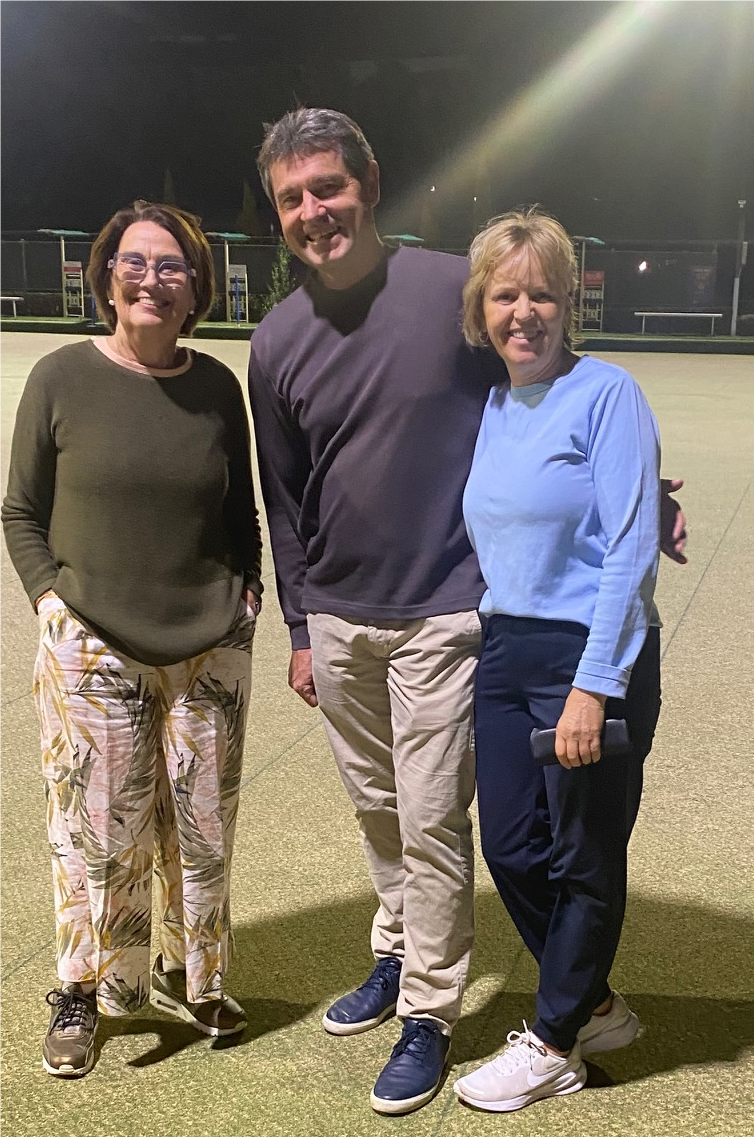 We had a highly talented team as you would expect........the only deficiency was, for the most part, it did not extend to lawn bowling. Play got underway at 7pm. Mitcham decided that they would pit their 2 best bowlers who bowl every week up against our two, in the form of Robyn and Greg McLeod, who have been our most consistent 'once-a-year' bowlers for ages. You would be shocked to hear that we failed to wrestle back the trophy! In terms of David v Goliath, the evil Goliath prevailed