Guest Speaker: The Great PUB Quiz.......Unley v Brownhill Creek (Creekers for short)
Chairman: Heather Kilsby
Guests: Linda England, Graham Ey, Graeme Kewen, Kate Muller, Margaret Payne and Anne & Kym Bills, Sorel & Jane Coward, Geoff & Anne Thomas
Visiting Rotarians: Briony Casburn, John Holds (Whyalla) plus 32 Creekers led by their President Tony Dorrington
Apologies: Graham & Patsy Beckett, Sheila Evans, Geoff Hill, Mavis Martin, Ali & Soheila Mostaghim, Alex Jonson
Attendance: 25 Members 44 Guests
President Heather's Announcements
The Creekers were welcomed to the club......and President Tony Dorrington responded by opening their meeting 1874
A list is being circulated to ascertain interest to attend the White Ribbon breakfast on 24 November 2017
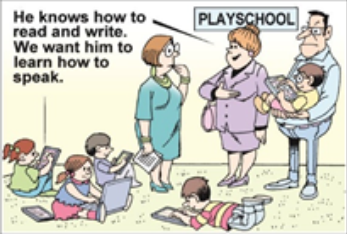
The Pub (??) Quiz...............
Quiz Masters Geoff & Anne Thomas were introduced to the club by Trevor McGuirk...... they share an interest in recyclables and close to $8000 has been raised for the Kids of Cusco. There was some comfort in the questions in that none could have been answered by an 18 year old..........of course those of us at the other end of the age spectrum knew plenty of the answers but had a few problems gouging them out from the recesses of the brain. It must be said that the Creekers had a bloody good night.........not only did they scoop most of the raffle pool reserved for Unleyites but also somehow won the quiz. The top table for the night was table 4 ably led by David Payne and included Margaret, Anne & Kim Bills, Vera Holt, Valerie Bonython, Graham Ey and Stephen the elder. In the end, weight of less numbers told, and the Creekers scored a table average higher than that achieved by Unley. They continue to be too smart by half. Congratulations to the Creekers and muchos gracias to our skilled quiz team.
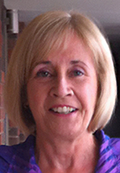
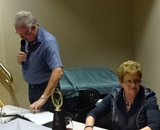
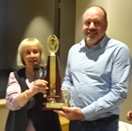
Above right are Geoff and Anne, and below are the madding crowd and the trophy presentation by the Prez to Tony Dorrington.
Spots
Tonight we were spotless, AGAIN!
The Finale
The meeting closed at 8.25 pm.....chair stacking (as opposed to number stacking followed).
Jerry reminds us that this year's search by Unley Rotary and the Unley Road Association for the best small businesses, best employee and best age friendly operator (sponsored by Unley Council) along Unley Road will be finalised by next Friday 22 September. Get those nominations in!
Rotary News
On the Rotary Calendar, September is Basic Education and Literacy Month
Education breaks the cycle of modern slaveryby Nikki Kallio
While many people would like to think that slavery was a tragedy of the past, the truth is that it still exists today, with up to 46 million people enslaved worldwide.
“It’s this Rotarian attitude – you give them a problem and instead of throwing their hands up in dismay, they start chipping away at it piece by piece,” says Carol Hart Metzker, a member of the action group. “Maybe slavery won’t be solved in my lifetime, but in two more years, we’re going to have a whole hamlet free.”
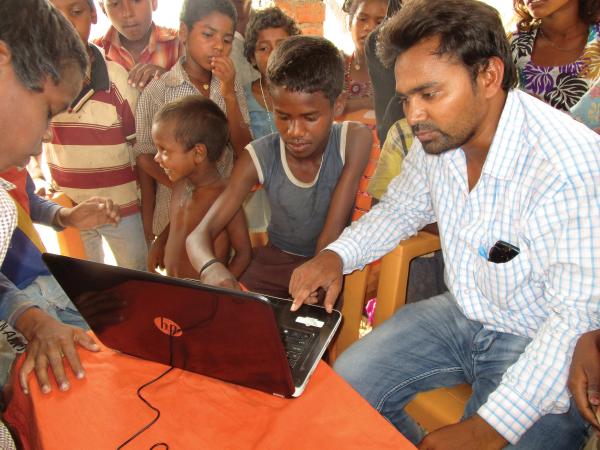
The students learn to use a computer, which is also used to document the project........Voices4Freedom/Schools4Freedom
In a village in northeastern India, the action group is tackling the problem of debt bondage. With the help of 13 clubs, a district grant through the Rotary Club of Binghamton, New York, USA, and other sources, the action group is providing $36,000 toward the work of Schools4Freedom, a project of the organization Voices4Freedom. Schools4Freedom works with local partner organization Manav Sansadhan Evam Mahila Vikas Sansthan (MSEMVS) to battle debt bondage.
The RAGAS project will support the efforts in one of those villages for three years. The name of the village, which is in the Uttar Pradesh state, is kept secret to protect the villagers and aid workers.
Poverty, illiteracy, innumeracy, and natural disasters that destroy crops or homes can leave villagers vulnerable to debt bondage in rural villages.
“When people don’t have enough to eat, and they barely have the ability to keep a roof over their head and their family quite literally alive, they will often turn to whatever means are possible for survival,” Metzker says.
Families may seek an arrangement with a business owner, who asks them to sign a contract that they can’t read and therefore can’t understand, and they inadvertently trade their freedom for survival, she says.
“The slaveholder creates a scheme such that the interest is more than the family ever makes, so no money really changes hands, and the family gets further and further into debt,” Metzker says. “That contract is never paid off.”
Of the village’s 400 residents, 132 are living in debt bondage, enslaved in the slaveholder’s brick kilns, farm, or construction projects, she says. “The others are at risk because they, too, are in abject poverty.”
Hundreds of thousands of people in Uttar Pradesh and the neighboring state of Bihar are working in forced labor in industries including agriculture, domestic servitude, commercial sex, stone quarries, or brick kilns, says Bhanuja Sharan Lal, director of MSEMVS.
The problem is exacerbated by inaction on anti-slavery laws, caste discrimination, discrimination and violence against women, lack of effective protection for children, lack of training of front-line officials, and corruption, Lal says.
“Businesses and landlords, mostly in the informal sector, face no effective sanctions for holding and using people in forced labor,” he says. “The status quo survives because in many industries the business model relies on debt bondage as a means to control workers.”
The Schools4Freedom project establishes a school, including funding for two teachers. Children receive school supplies and three years of hot lunches. The village gets a computer to document the project. A solar light is installed in the village to help protect children from snakebites and help prevent sexual assault against women. Women are trained in a trade.
“What’s so amazing about Schools4Freedom is that one removes all of these vulnerabilities,” Metzker says. “You strengthen the people and then you teach them that they have basic rights so that they can go and, in a sense, demand that freedom themselves.”
Funds also pay for a simple school structure of brick pillars with a corrugated tin roof. It keeps the extreme heat and rain at bay, “but it’s not such an amazing building that someone can take it over,” she says. “It’s not so valuable that a slaveholder would burn it down to stop the process.”
Most important, the project pays for two front-line workers who are local and highly specialized in educating the villagers. The workers teach them that they have basic human rights such as freedom and access to government services – and all of this is done quietly at first, Metzker says.
“You have to know how to do it, when to do it, the safe way to do it so that the front-line workers themselves and the villagers don’t take the brunt of a slaveholder’s anger,” she says. “We can’t, as Rotarians, do that job.”
The school structure is usually the first sign to the slaveholders that something may be happening, and they may ridicule the children for getting an education, trying to convince them that it’s pointless.
“Does the slaveholder think about where that’s going in two or three years? The writing is on the wall,” Metzker says.
Sometimes slaveholders, not wanting to lose the labor, will create employment arrangements with the villagers. Other times, slaveholders become violent and the situation requires legal action, she says.
The three-year process ensures time for the entire village to see that it is in a position of strength.
Additionally, liberated villages are connected to a network of other freed villages, to continue supporting one another, says Peggy Callahan, co-founder of Voices4Freedom.
The problem of debt bondage is insidious because it can entrap multiple generations. But with the project efforts, “not only will these people be free and educated and able to build a life of dignity, but their children and grandchildren and great-grandchildren will be born in freedom,” Callahan says.
Metzker, who is a member of the Rotary E-Club of One World D5240, became involved in anti-slavery efforts after a National Immunization Day trip to India in 2004, during which she visited a center for children who had been freed from slavery. She now works as a consultant to the Salvation Army’s New Day to Stop Trafficking program. She received Rotary’s Service Above Self Award in 2009-10.
“Someday, there is going to be such a huge difference because we realized there really is something you can do,” she says. “And we did it.”
Upcoming Events
RYLA September 23-29 Nunyara Conference Centre.
RYLA Graduation dinner Thursday 28 September
COUNTRY CAR CRUISE (The Unley Redex Car Trial) 29 October
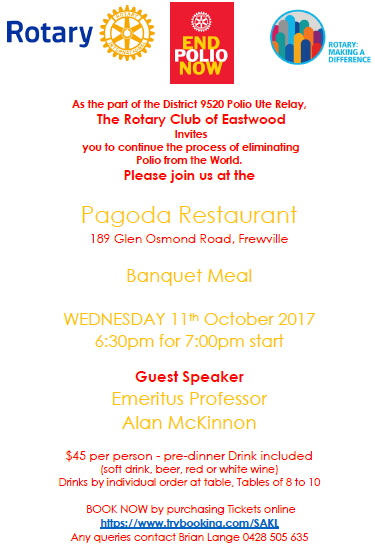
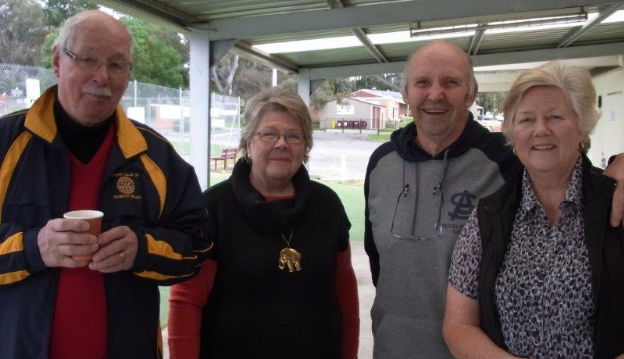
Patsy reminds us all of the Challenge with RC Eastwood, and dearly wants stronger participation and outcome......even greater fun this year. She insisted a photo be used to highlight the occasion but the choice is very limited.....this is about the best.
Our Upcoming Meetings
26 September 2017 atDamien on Fisher at 6 for 6.30pm Dr Grant Whiteman - Calperum Update
Chair: Dennis Liddle | Set-up, Welcome & Attendance: L Kewen & D Liddle
3 October 2017 atDamien on Fisher at 6 for 6.30pm Peter Sullivan, Principal of Unley Primary School and Brenda Hughes, Principal of Unley High School - Schools Night
Chair: Rhonda Hoare | Set-up, Welcome & Attendance: T McGuirk & D Middleton
26 September 2017 atDamien on Fisher at 6 for 6.30pm David Cockshell - Donations in Kind and Clearing the RAH
Chair: Graham Beckett | Set-up, Welcome & Attendance: R Mills & R Mullins
Usual Meeting Venue: Damien on Fisher, 123 Fisher Street, Fullarton SA 5063
Apologies to: Stephen Baker as early as possible by e-mail sandbbaker@internode.on.net or 0403 687 015



 Quiz Masters Geoff & Anne Thomas were introduced to the club by Trevor McGuirk...... they share an interest in recyclables and close to $8000 has been raised for the Kids of Cusco. There was some comfort in the questions in that none could have been answered by an 18 year old..........of course those of us at the other end of the age spectrum knew plenty of the answers but had a few problems gouging them out from the recesses of the brain. It must be said that the Creekers had a bloody good night.........not only did they scoop most of the raffle pool reserved for Unleyites but also somehow won the quiz. The top table for the night was table 4 ably led by David Payne and included Margaret, Anne & Kim Bills, Vera Holt, Valerie Bonython, Graham Ey and Stephen the elder. In the end, weight of less numbers told, and the Creekers scored a table average higher than that achieved by Unley. They continue to be too smart by half. Congratulations to the Creekers and muchos gracias to our skilled quiz team.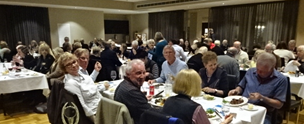
 RYLA September 23-29 Nunyara Conference Centre.