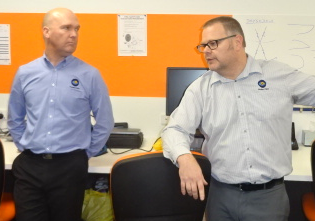
 Jason Booth introduced Dave Jacobs the Clinic Manager and commented that he and Dave had collectively been into eyes for 50 years. WOW...their vision should now be perfect. Both had come from the private sector (OPSM and Laubman and Pank). The Optometry course was established at Flinders Uni in 2010. Teaching of optometry involves 3 years Bachelor of Medical Sciences (Vision Science) study followed by 2 years for a Master of Optometry. The course includes work experience in retail establishments around Australia.....some students have even been fortunate to score overseas placements.
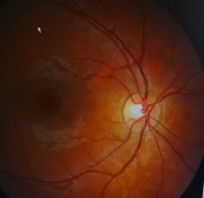 We were taken on a tour. At the front, Flinders Vision is a bit like Specsavers. To the side and to the rear there are laboratories and training rooms.
 Course enrolment is now about 70 students per year and 1500 to 2000 people volunteer to have their sight tested. Often people are referred to Flinders when optometrists and eye specialists detect a problem but lack the equipment to fully diagnose it. Macular degeneration is hereditary and smoking increases the risk of blindness significantly.....unlike the myth about too much......

Eric Lee and his wife hand out supplies to refugee children in Bangladesh.
Service above self was the underpinning of our aid project for Rohingya refugees in Bangladesh this year. The project was a colorful example of how Rotary works around the globe in the service of others. Clubs from the United States and Bangladesh delivered dry goods to Rohingya refugees in the Bahlukali camp along the Bangladesh-Myanmar border in February.
The Rohingya are an ethnic minority who fled violence in Myanmar for refugee camps in southern Bangladesh. More than 700,000 refugees have entered Bangladesh since August 2017, and most came with just the clothes on their back. They are in desperate need of food, supplies and basic sanitation.
Cox’s Bazaar is the closest city to the Rohingya refugee camps, and the Rotary Club of Cox’s Bazaar engages other clubs and various non-profits to facilitate the delivery of goods and services. The Rotary Club of Cheat Lake in West Virginia, USA, coordinated efforts with Cox’s Bazaar Rotary to deliver clothing, personal hygiene products, and water purification tablets to the Rohingya refugees in Bangladesh.
Challenges like transferring goods, security on the ground, and obtaining proper authorization were managed between the two Rotary clubs. The goods were purchased and shipped from wholesale markets from the capital of Bangladesh, Dhaka. Once the products arrived in Cox’s Bazaar, then our group worked in a small bungalow on the Bay of Bengal preparing separate packages for men and women.
Maji, or tribal captains, are village leaders that manage groups of about fifty families. They were instrumental in helping coordinate with the army and determine fair distribution across thousands of refugees. Many refugees were shaking as they came through the line to receive their package. Some were sick, some were visibly scared.
Distribution went off without a hitch, in part, because members from multiple Rotary clubs made a significant contribution to the project. Together they established resources and logistics for the safe and successful distribution of aid. Rotary clubs around the world should look to examples like this for ideas on future refugee service projects.