
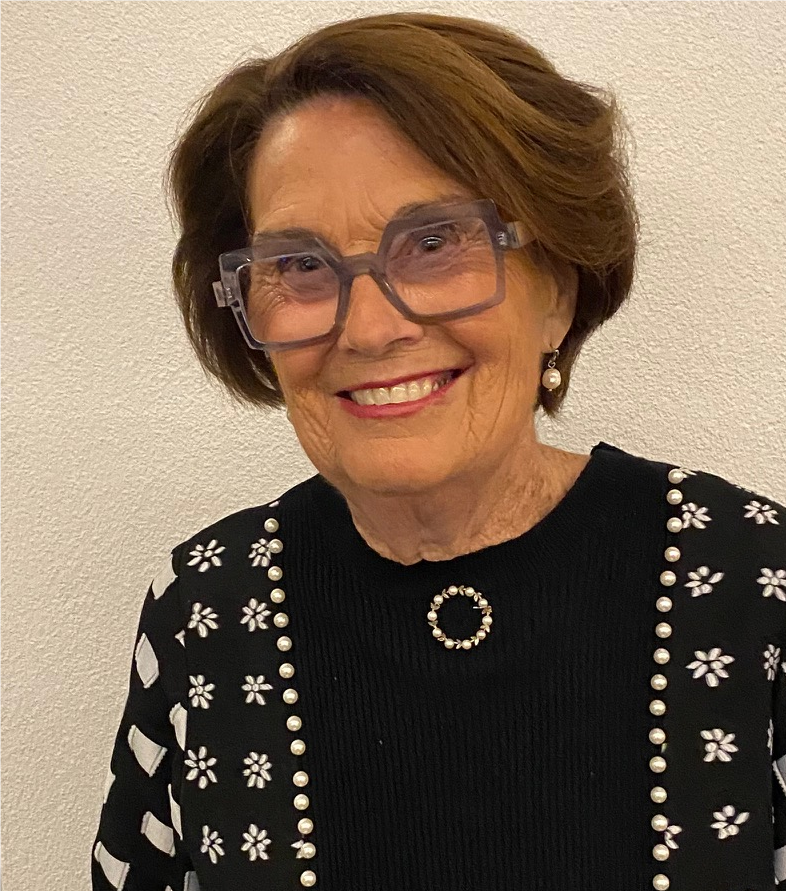
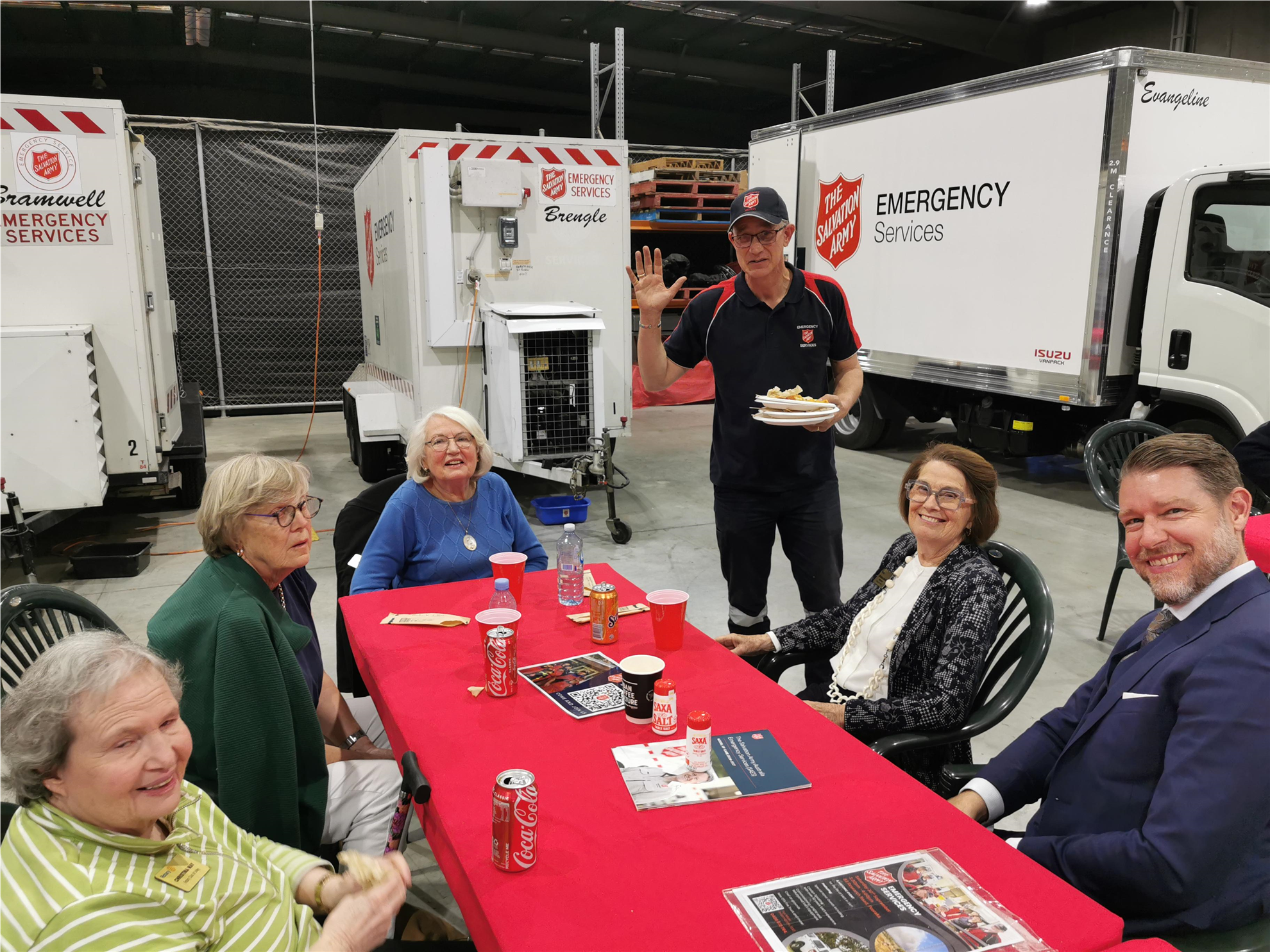
 It’s not a long way from Unley to Pooraka, about 20 kilometers in total, a 20 minute drive at 60 kilometers per hour without delays. But getting there for a 6pm start made for a journey of more than an hour, and caused two of us, including your newsletter editor for the week to be locked out on arrival. So I missed the start of the presentation by Reno Elms, our previous member for almost 18 years as the head of the Unley branch of the Salvation Army. Reno’s three boys are boys no more, and one has provided the Elms with two young grandsons.
 ith a delicious and nourishing meal to keep them going, and sometimes doing something quirky to add a sense of fun. The triumph is often acknowledged by the others in the form of heartfelt thanks (sometimes delivered in the taciturn style of the battle-hardened recipients).
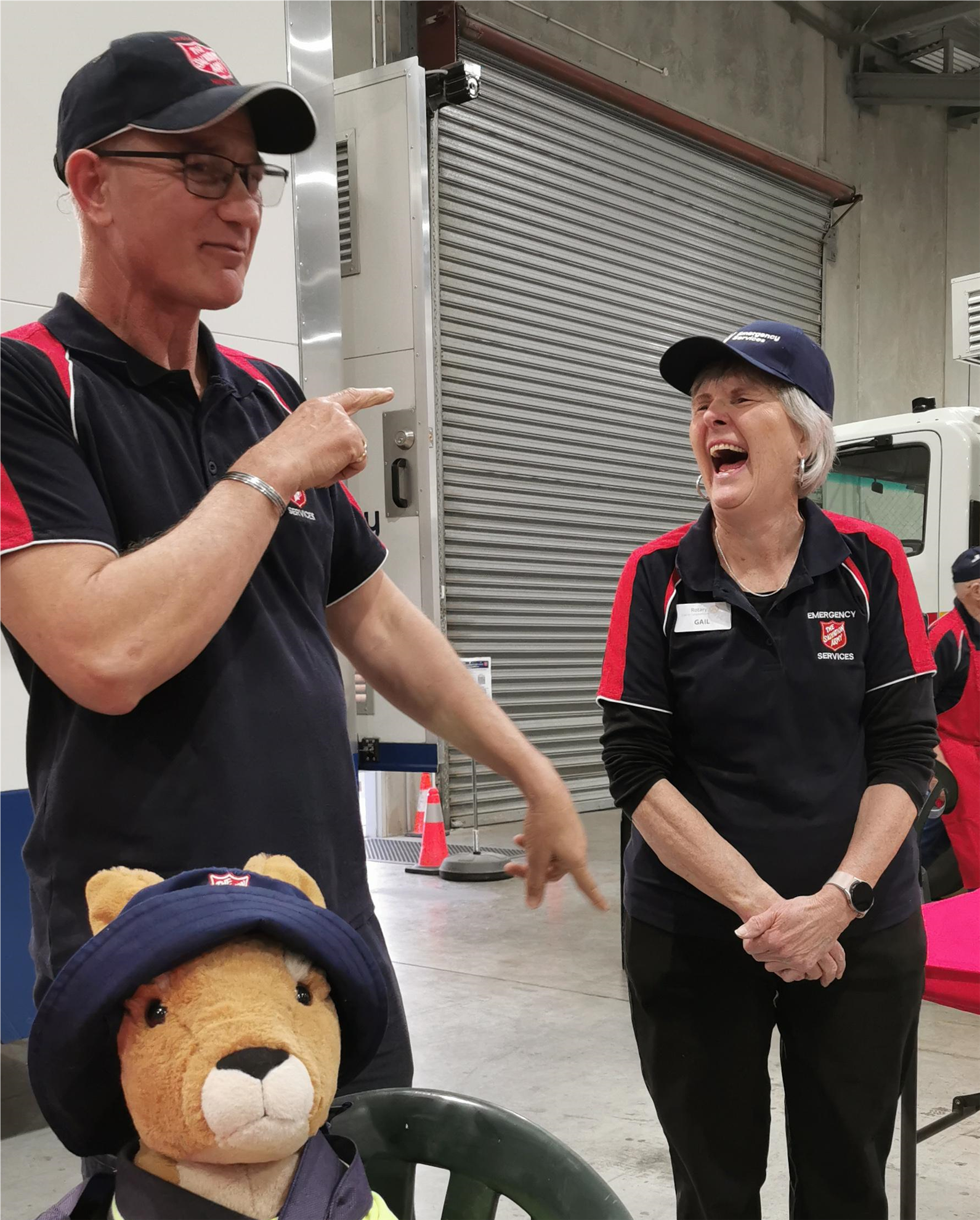 We were then treated to dinner of schnitzels, crunchy potato bits and veg, followed by fruit salad and icecream. Our group attending enjoyed the fellowship and the involvement with the Salvation army volunteers doing the catering.
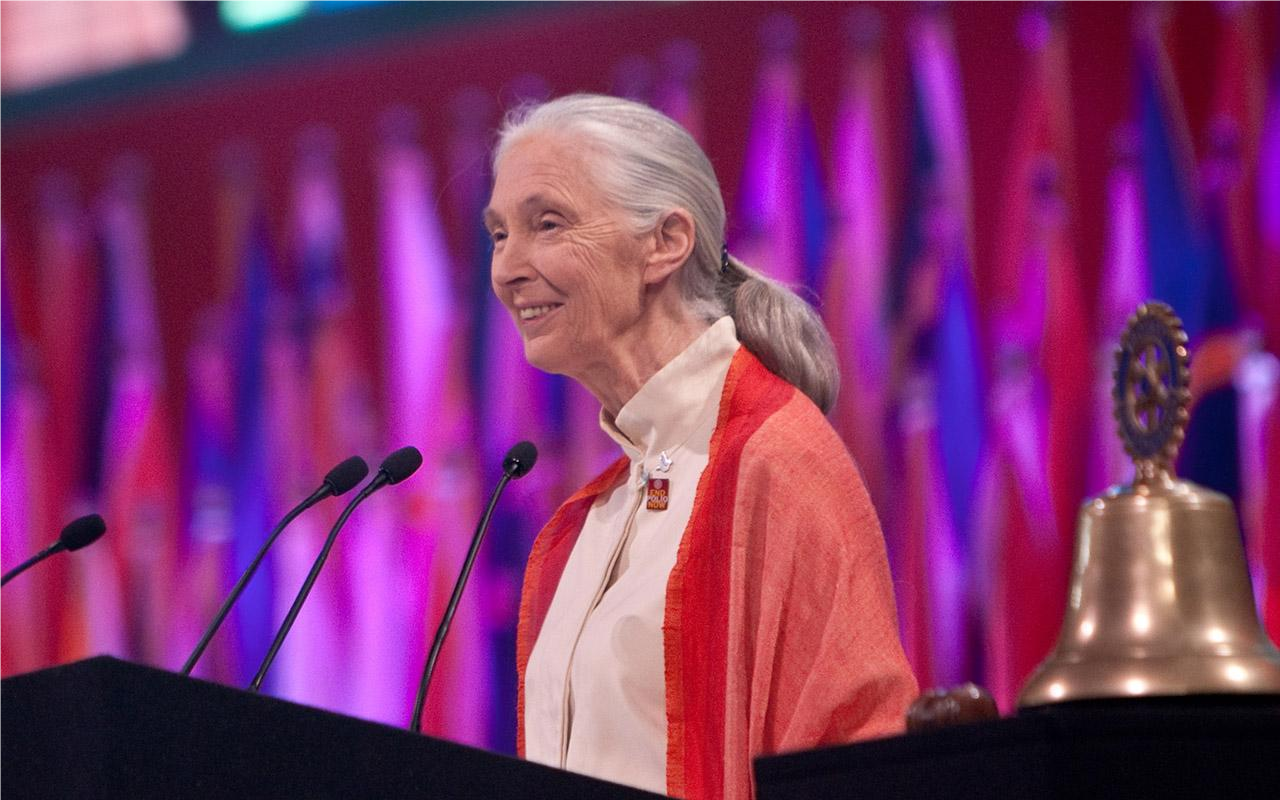 The Rotarian: You characterize humans as one of the five great apes. How do we fit in?
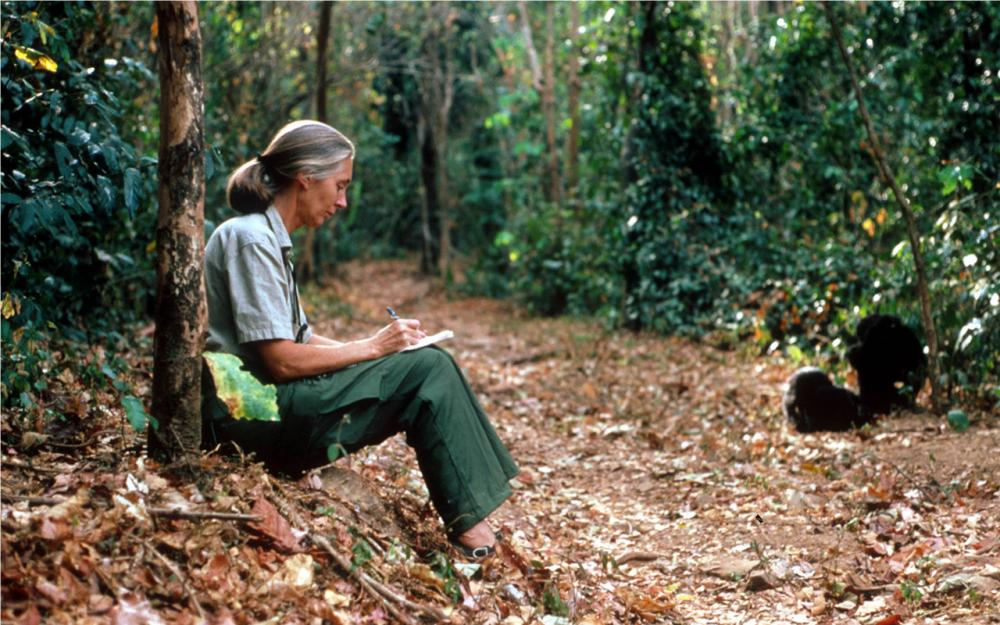 TR: In your first book, In the Shadow of Man, you wrote movingly of chimps suffering from polio. Eradication of the disease is Rotary’s major initiative.
Goodall: I know it well. Polio was endemic in Tanzania. And in parts of Central Africa, it’s very difficult because you can’t get to the people there. The countries are in turmoil, and there’s no good infrastructure.
TR: Some years ago, you made a decision to forgo scientific work for animal and environmental advocacy. Was it a tough call?
Goodall: It was a decision I had to make. Looking back, what an egoist I must have been to think I could make a difference. I went to this big conference in 1986. All the chimp researchers were there, along with people who had information about the treatment of chimps in labs. It was so shocking. It was a lovely life out there in the field at Gombe – collecting information, analyzing it, and writing books. Then, suddenly, I knew I couldn’t be a scientist anymore.
TR: The Jewish scholar Abraham Joshua Heschel has described prophets as “troublesome people.” Do you accept that as part of your job description?
Goodall: Yes. You have to make people a bit uncomfortable first. But it’s my job to give them hope. A lot of people don’t know what to do [for the environment]. Do simple things. The grocery store is three blocks away. Make a choice to walk there with your own bag instead of taking their plastic. Try to get familiar with products that are made in an environmentally ethical way. Don’t buy water in a bottle that comes from 2,000 miles away. I drink tap water everywhere, and if the tap water is bad, filter it. Switch off your computer. Turn off all these appliances we leave burning away. There’s so much you can do.
TR: Does the great wealth gap between the developed countries and emerging nations make it tougher to instill environmental awareness among less well-off populations?
Goodall: One of the factors contributing to environmental destruction is poverty. You have to cut trees down to try to grow food to feed yourself and your family, but soon the soil becomes overused. You know it’s going to create desert, but what can you do if you’re very poor? Politicians want to sell the forest and minerals for big money. That’s where the rot comes in. Even a responsible company will open up the forest with roads, and that lets the hunters go in. Then you get the bush meat trade. The urban elite will pay for elephants down to birds and bats.
TR: What happens to the people who live there?
Goodall: Around Gombe, where the environment is destroyed, that means the chimps aren’t there. But the people in that situation are also struggling to survive, which is why we started TACARE (Lake Tanganyika Catchment Reforestation and Education), a community-based conservation project. Our Tanzanian team – not white people – went into the villages, sat down in the traditional Tanzanian way, exchanged news about friends and family, then asked how they could help. Did the people care about conservation? No. They cared about health and education for their children. So that’s how we began. After a bit, we could help with farming methods to restore the overused soil without chemical fertilizer. Within two years it was productive again. Then came water systems, sanitation, microcredit for groups of women, family planning, HIV/AIDS education, information about women’s and children’s rights. And the last piece of this puzzle: conservation. They’re now agreeing to put 10 to 20 percent of village land into forest protection and restoration. These forest patches are in a contiguous line so that the Gombe chimps finally have a way out of their closed-in patch of forest.
TR: You’ve marveled at the resilience of nature despite humans’ abuse of the environment.
Goodall: We’ve bashed nature for years. But I’m amazed at the resilience of the planet. My favorite story is about a quarry that had been used by a cement company near the coast of Kenya. In the early ’70s, the guy who owned the company was suddenly horrified to fly over and see this huge scar. He hired a Swiss horticulturist, who found a tiny little plant growing. He got more of those, and they began to grow and their needles fell. Then he found a millipede, which was eating the needles and turning them into soil. So he got more of those. Water began coming back. There are hippos there. They’ve used half the quarry for sustainable farming, and they’ve even got a fish farm there.
TR: You’ve used the adjective “thorny” in speaking about issues involving people and environmental action.
Goodall: Life is not black and white. You have to help children understand that. The easy thing, if you’ve got children involved, is to have them save money and buy a piece of rainforest somewhere. But if you want to protect a piece of prairie on your own doorstep, the people who want to buy it have faces you know – maybe it’s the face of your best friend’s father. You very quickly learn it isn’t easy. There are people who want jobs, who want a business to come in that might destroy the environment. You might hurt somebody else who’s making a living farther down the river.
TR: Do you see the current economic crisis harming the environmental movement?
Goodall: It will hurt people like organic farmers because it does cost more to buy organic food. In England it already has. On the other hand, horrible large-scale developments are being put on hold, and that buys a little more time for environmentalists to band together to protect the areas.
TR: Environmental and wildlife charities always adopt cute animals – chimps, baby seals, polar bears – as their fundraising mascots. Is there an ugly species whose contribution to the environment we should acknowledge?
Goodall: Probably these centipedes we have at Gombe. They can grow to something like 9 inches or a foot. They’re very flat. They have a very poisonous bite. If you’re allergic, they could kill you. They could probably kill a child. I once had one crawl up my leg. Fortunately, it climbed down. I just don’t like them. But these centipedes are very good at making compost. They have a job to do, and they do it very well.
Every single day we make an impact on the world, and we have a choice as to what kind of impact we’re going to make.
TR: Do you feel there is a disposition to idealism and volunteerism, which can be nurtured in very young children?
Goodall: Give me a child up until age seven, and I’ll have him for life. It’s really true that people do get so much of who they are from those early years. There are three aspects of Roots and Shoots: animal, people, environment. There are always some children who are passionate about one aspect or another. They can choose which area they want to get involved in. But then they’re peripherally involved in the other projects. That’s why it’s working so well. They’re learning to live in peace and harmony with each other and the environment.
TR: You receive many more invitations to speak than you can possibly accept. Why did you agree to address Rotary’s 100th annual convention?
Goodall: I’ve talked to Rotarians in South Africa and in different parts of Europe. We had a board chair of the Jane Goodall Institute in Tanzania who is a Rotarian. They do good things. I shall emphasize something Rotarians probably know: Every single day we make an impact on the world, and we have a choice as to what kind of impact we’re going to make. We have desperately harmed this planet, and at some point we shall reach the point of no return. It’s not too late, but it’s going to require all of us to make an effort.
TR: Might there be synergies between your initiatives and those of Rotary?
Goodall: I’ve talked about having Rotarians’ kids be part of Roots and Shoots. If that’s something that could come out of this meeting, that would be fantastic, because the Rotarian mission is the same as ours. Well … we probably care more about animals.
TR: Your National Geographic appearances once led you to be described as that magazine’s “cover girl.” Did you save those covers?
Goodall: (Laughs.) I used to loathe it. Now I think it’s funny. I suppose I have the covers somewhere.
Warren Kalbacker is a journalist based in New York City.